Anti Corruption
Cheque Bounce
Civil
+8
Cheque Bounce · Bhopal
Cheque Bounce Lawyers in Bhopal – Strong Legal Support for Dishonoured Cheque Cases
51 verified cheque bounce advocates practising in Bhopal. Compare experience, courts, languages and client ratings before you make contact.
Cheque dishonour disputes can create serious legal and financial consequences for businesses, lenders, individuals and other parties involved in financial transactions. When a cheque issued towards a legally enforceable debt or liability is returned unpaid, the drawer and payee may become involved in proceedings under Section 138 of the Negotiable Instruments Act, 1881, subject to fulfilment of the statutory requirements.
Cheque Bounce Lawyers in Bhopal assist both complainants and accused persons in handling cheque dishonour proceedings before the competent courts. Bhopal courts continue to hear Section 138 matters involving disputed payments, business transactions, loans and other financial liabilities. Current Bhopal court records include pending criminal complaint cases specifically registered under Section 138 of the Negotiable Instruments Act.
A cheque-bounce case is not determined merely by showing that a cheque was returned unpaid. Statutory requirements concerning presentation of the cheque, dishonour, demand notice and failure to make payment within the prescribed period can become important. The legal notice therefore plays a significant role in a Section 138 case. In 2026, the Madhya Pradesh High Court addressed the issue of proof of service and held that a Section 138 complaint should not automatically fail merely because a tracking report for the statutory notice is unavailable where service can otherwise be legally presumed.
The underlying transaction is equally important. A cheque may arise from a loan, sale of goods, business dealings, services, settlement of accounts or another legally enforceable obligation. The parties may disagree about whether any liability existed, whether the cheque was issued towards that liability, whether payment was already made or whether the cheque was issued as security subject to conditions. These factual issues can directly affect the defence and evidence in a cheque-bounce proceeding.
The statutory presumptions under the Negotiable Instruments Act can also become important. The accused may seek to rebut the applicable presumptions through the evidence available in the case. Recent Madhya Pradesh High Court proceedings have examined the accused's opportunity to produce defence evidence and the role of handwriting evidence in a Section 138 prosecution.
Cheque-bounce disputes can also progress beyond the initial complaint. A case may involve summons, appearance, evidence, cross-examination, defence evidence, arguments and judgment. If a conviction is recorded, appellate remedies may become relevant. Bhopal courts have recently dealt with appeals involving Section 138 convictions, including a 2026 appellate decision in which a conviction was set aside and the accused was acquitted.
The amount involved can range from relatively small personal transactions to substantial commercial liabilities. Larger disputes may involve invoices, agreements, account statements, loan documentation, correspondence and multiple cheques. Proper organisation of these documents can be important when establishing or contesting the underlying liability.
For businesses in Bhopal, cheque dishonour may arise from unpaid invoices, delayed commercial payments, supply transactions or outstanding contractual dues. For individuals, it may involve personal loans, repayment arrangements or other financial obligations. The appropriate legal strategy depends on the transaction, documents, cheque history and statutory compliance.
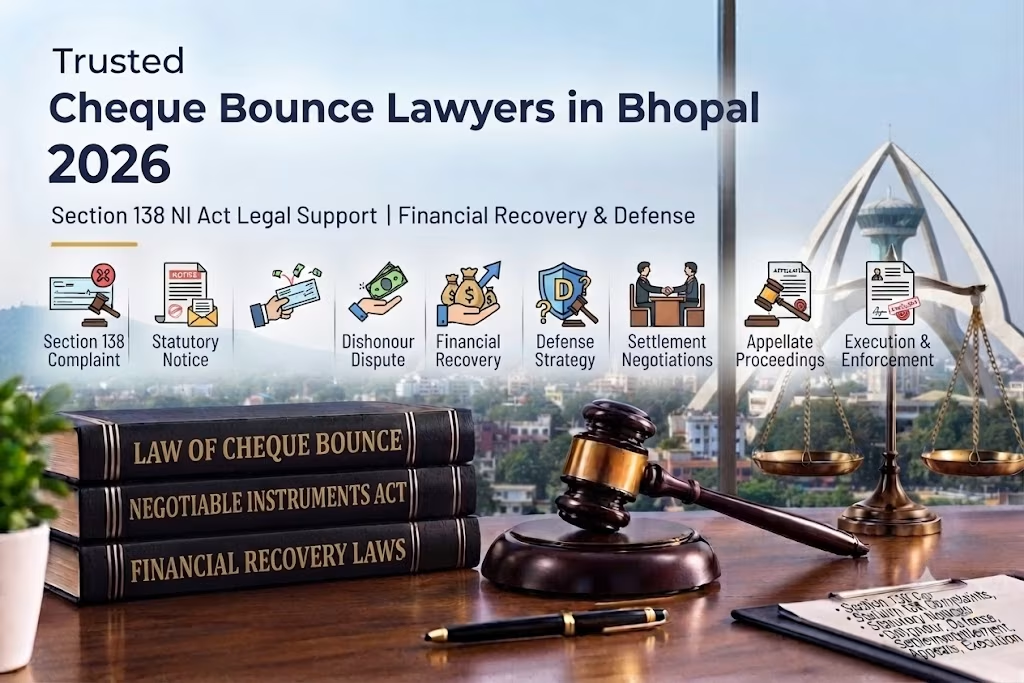
Cheque Bounce Lawyers in Bhopal can assist with statutory notices, preparation of complaints, responses to allegations, evidence, cross-examination, settlement discussions, defence strategy and available appellate proceedings. The objective is to address the specific cheque transaction and the legal requirements applicable to the case rather than treating every dishonour dispute in the same manner.
Cheque Bounce Legal Services in Bhopal
Cheque Bounce Lawyers in Bhopal can assist with:
- Section 138 NI Act complaints
- Cheque dishonour legal notices
- Reply to cheque bounce notices
- Defence in cheque bounce cases
- Evidence and cross-examination
- Disputes concerning legally enforceable liability
- Security cheque disputes
- Business and commercial cheque disputes
- Loan repayment cheque disputes
- Cheque bounce settlements
- Appeals against conviction
- Revision and higher-court remedies where applicable
- Cheque-related interim applications
Section 138 Cheque Bounce Cases
Section 138 of the Negotiable Instruments Act deals with dishonour of cheques in circumstances prescribed by the statute.
A Section 138 Lawyer in Bhopal can examine the cheque, return memo, underlying liability, statutory notice and subsequent proceedings to determine the appropriate legal approach.
Cheque Bounce Legal Notice
The statutory demand notice is a critical stage in a cheque dishonour matter.
A Legal Notice for Cheque Bounce in Bhopal should be prepared with attention to the cheque details, dishonour information, payment demand and applicable statutory requirements.
Filing a Cheque Bounce Complaint
Where the statutory requirements are fulfilled and payment is not made within the prescribed period, the payee may initiate a complaint before the competent court.
A Cheque Bounce Case Lawyer in Bhopal can assist with drafting the complaint, supporting documents and procedural requirements.
Defence in Cheque Bounce Cases
The accused may dispute the existence of liability, issuance of the cheque, amount claimed, circumstances surrounding the transaction or other relevant facts.
A Cheque Bounce Defence Lawyer in Bhopal can analyse the complainant's documents, cross-examine witnesses and present the available defence evidence.
Legally Enforceable Debt or Liability
The existence of a legally enforceable debt or liability is an important issue in Section 138 proceedings.
Disputes may arise concerning repayment, prior settlement, consideration, part-payment, adjustment of accounts or the actual amount outstanding.
Security Cheque Disputes
A cheque described as a security cheque does not automatically resolve the legal issue in favour of either party.
The circumstances in which the cheque was issued, the underlying agreement, the liability existing when the cheque was presented and the conditions attached to its use may require examination.
Recent Madhya Pradesh High Court decisions have considered disputes involving security cheques and the existence of legally enforceable liability.
Evidence and Cross-Examination
Cheque-bounce litigation can involve documentary and oral evidence relating to the transaction.
Bank records, cheque return memos, notices, delivery records, invoices, agreements, account statements and correspondence may become relevant depending on the dispute.
Cheque Bounce Cases Involving Businesses
Commercial cheque disputes may involve unpaid invoices, supply contracts, services, business loans or settlement of accounts.
A Cheque Bounce Lawyer in Bhopal can examine the commercial documents alongside the cheque and identify the issues relevant to the Section 138 proceedings.
Loan and Personal Payment Disputes
Cheques issued for repayment of loans or other personal financial obligations can also result in Section 138 proceedings.
The parties may dispute the amount advanced, repayment, interest, documentation or whether a legally enforceable liability remained when the cheque was presented.
Settlement and Compounding
Parties may explore settlement during the pendency of a cheque-bounce case.
A settlement may address payment of the outstanding amount and closure of the proceedings in accordance with the applicable legal procedure.
Cheque Bounce Appeals
A conviction in a Section 138 matter may be challenged through an appropriate appellate remedy.
A Cheque Bounce Appeal Lawyer in Bhopal can review the judgment, evidence and grounds of challenge and advise on the appropriate appellate proceedings.
Recent Bhopal appellate proceedings demonstrate that Section 138 convictions can be examined by the appellate court on issues concerning liability, evidence and statutory compliance.
Madhya Pradesh High Court Remedies
Certain orders arising from cheque-bounce proceedings may require consideration before the Madhya Pradesh High Court at the appropriate stage.
The applicable remedy depends on the nature of the order, procedural history and grounds being raised.
Why Choose Professional Cheque Bounce Legal Assistance?
Cheque-bounce litigation is closely connected with statutory timelines, documentary evidence and the underlying financial transaction.
Professional legal assistance can help with:
- Section 138 complaint preparation
- Statutory demand notices
- Defence strategy
- Evidence and cross-examination
- Financial and transaction documents
- Security cheque disputes
- Settlement negotiations
- Appeals and further remedies
A focused approach helps ensure that the cheque, bank return memo, notice, underlying liability and court proceedings are considered together.
51 advocates
Anti Corruption
Anticipatory Bail
Arbitration
+8
Arbitration
Cheque Bounce
Consumer Court
+6
Anti Corruption
Cheque Bounce
Civil
+6
Anti Corruption
Cheque Bounce
Civil
+9
Arbitration
Bankruptcy / Insolvency
Breach of Contract
+10
Arbitration
Cheque Bounce
Civil
+7
Anti Corruption
Anticipatory Bail
Arbitration
+41
Anti Corruption
Banking / Finance
Cheque Bounce
+6
Cheque Bounce
Civil
Cheque Bounce
Civil
Criminal
+2
Banking / Finance
Cheque Bounce
Civil
+2
Cheque Bounce
Civil
Criminal
+2
Cheque Bounce
Consumer Court
Motor Accident
+1
Cheque Bounce
Civil
Criminal
+2
Anti Corruption
Anticipatory Bail
Arbitration
+14
Anti Corruption
Cheque Bounce
Civil
+10
Anti Corruption
Anticipatory Bail
Cheque Bounce
+13
Arbitration
Cheque Bounce
Consumer Court
+8
Arbitration
Breach of Contract
Cheque Bounce
+8
Anti Corruption
Cheque Bounce
Civil
+8
Anti Corruption
Cheque Bounce
Criminal
+6
Arbitration
Cheque Bounce
Civil
+11
Cheque Bounce
Child Custody
Divorce
+3
Load more advocates
Showing 24
of 51
Browse by practice area in Bhopal
All Bhopal lawyers
Criminal (57)
Civil (54)
Family (51)
Consumer Court (46)
Divorce (44)
Anti Corruption (44)
Pocso Act (42)
Dowry Case (41)
Pmla (41)
Litigation (39)
High Court (33)
Domestic Violence (30)
Anticipatory Bail (29)
Property (29)
Arbitration (27)
RERA (26)
Court Marriage (23)
Corporate (22)
Motor Accident (19)
NCLT (14)
Documentation (14)
Breach of Contract (14)
Recovery (14)
Labour & Service (14)
Bankruptcy / Insolvency (13)
Banking / Finance (12)
Fraud Case (12)
Succession Certificate (12)
Trademark & Copyright (12)
Women (11)
Child Custody (11)
Media and Entertainment (10)
Cyber Crime (9)
Insurance (8)
Landlord / Tenant (8)
Patent (7)
Startup (7)
Tax (5)
Wills / Trusts (5)
Supreme Court (4)
Medical Negligence (4)
Customs & Central Excise (4)
GST (3)
Muslim Law (2)
R.T.I (2)
NRI (1)
International Law (1)
Cheque dishonour disputes in Bhopal require attention to both the financial transaction and the statutory requirements governing Section 138 proceedings. A returned cheque by itself does not tell the complete legal story. The circumstances in which the cheque was issued, the liability for which it was presented, the reason for dishonour, the statutory notice and the subsequent payment position can all become relevant.
Cheque Bounce Lawyers in Bhopal assist payees seeking recovery through Section 138 proceedings as well as accused persons defending allegations arising from dishonoured cheques. Current Bhopal court records show active Section 138 complaint proceedings before the District and Sessions Court, including cases involving evidence and continuing hearings.
For a complainant, one of the first important considerations is whether the statutory requirements have been satisfied. The cheque must be handled within the applicable statutory framework, and the demand notice must properly address the dishonour and payment demand. Mistakes at the notice stage can create procedural issues later in the case. At the same time, proof of service should be assessed in light of the applicable legal principles. The Madhya Pradesh High Court's 2026 ruling concerning statutory notice service illustrates that the absence of a tracking report does not necessarily end a Section 138 complaint where service can otherwise be established or legally presumed.
For an accused person, the defence may focus on the underlying transaction and the complainant's ability to establish the necessary ingredients of the offence. Questions may arise about whether a legally enforceable liability existed, whether the cheque was issued for that liability, whether the claimed amount is correct, whether payment or adjustment had already occurred, or whether the cheque was being used in circumstances different from those alleged by the complainant.
Security-cheque disputes can require particularly careful examination. Simply describing a cheque as a security cheque does not by itself determine the outcome. The agreement between the parties, the purpose for which the cheque was delivered and the status of the liability when the cheque was presented can all be relevant. Madhya Pradesh High Court decisions in 2026 have considered the relationship between security cheques and legally enforceable liabilities.
Evidence can become decisive in contested Section 138 proceedings. Bank records, cheque return memos, invoices, loan documents, agreements, account statements, correspondence and other transaction records may need to be examined. Cross-examination may also be important where the complainant's version of the transaction or liability is disputed.
The accused may also need an opportunity to present a meaningful defence. A 2026 Madhya Pradesh High Court decision concerning a cheque-bounce prosecution considered the importance of permitting defence evidence, including handwriting-related examination where relevant to the issues raised in the case.
Commercial cheque disputes can become more complicated when multiple invoices, payments or transactions exist between the parties. In such matters, a simple comparison of the cheque amount with an alleged outstanding balance may not resolve the dispute. Account reconciliation, contractual terms, payment records and communications can become important in determining what amount, if any, remained payable.
Cheque-bounce litigation may also continue after the trial court judgment. Where a conviction is recorded, an appeal may be available subject to the applicable procedural requirements. A recent Bhopal appellate decision shows that a Section 138 conviction can be examined on appeal and may be set aside where the appellate court finds that the prosecution has not established the required liability.
Settlement can also be considered during the proceedings. Parties may negotiate payment of the disputed amount and seek closure of the case through the legally available mechanism. The terms of any settlement should clearly identify the payment obligations and treatment of pending proceedings.
For businesses and individuals in Bhopal, early legal review can help identify whether a cheque dishonour dispute should proceed through a Section 138 complaint, be defended on specific grounds, or be resolved through settlement. Important documents should be preserved from the beginning, including the original cheque, bank return memo, notice, proof of dispatch or service, transaction records and communications.
Cheque Bounce Lawyers in Bhopal can provide assistance at different stages, including preparation of statutory notices, filing or defending complaints, evidence, cross-examination, settlement, judgment review and appellate proceedings. The appropriate strategy depends on the facts and documents of each transaction.
A properly prepared cheque-bounce case should therefore focus on the actual financial liability, statutory compliance and available evidence. Whether the dispute concerns a business payment, personal loan, security cheque, outstanding invoice or another financial transaction, focused Section 138 legal assistance can help address the matter through the appropriate court process.
Frequently Asked Questions
A cheque-bounce case under Section 138 of the Negotiable Instruments Act may arise when a cheque is dishonoured in circumstances covered by the provision and the statutory requirements concerning notice, payment and initiation of proceedings are satisfied.
Yes, lawyers draft and send legal notices under Section 138 of the Negotiable A statutory demand notice may be required after dishonour, subject to the applicable requirements and timelines. The cheque return memo and relevant dates should be reviewed promptly before issuing the notice.Act to initiate the legal process.
Yes, a security-cheque defence can be raised where supported by the facts and evidence. The purpose of issuing the cheque, the underlying agreement and the status of the legally enforceable liability may be relevant.
Yes, parties may explore settlement during the proceedings. The settlement and closure of the Section 138 proceedings must follow the applicable legal procedure.
An appropriate appellate remedy may be available against a conviction, subject to the applicable law and procedural requirements. The judgment, evidence and grounds of challenge should be reviewed before filing the appeal.